Platform Width
Weight
Runtime Per Charge
Unilateral Data
90% of the data.
10% of the cost.
Force plates are the gold standard — and at $15,000–$30,000 a pair, they should be. But the vast majority of athletic performance testing doesn't require that level of investment. Contact time, flight time, jump height, RSI, left-right asymmetry, power output, BOSCO protocols — EzeJump delivers all of it.
EzeJump is a switched mat, not a force plate. It does not measure ground reaction force. What it does measure — with a patented stainless-steel switching mechanism that doesn't drift — is every time-based and flight-based metric your program needs, at a price point every team, school, and clinic can justify.
One mat. 13 test protocols. No lab required.
Contact Us
Every detail of the jump mat. Engineered for accuracy.
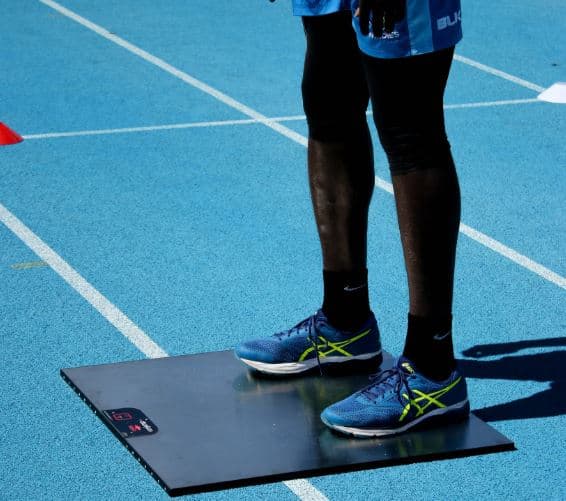
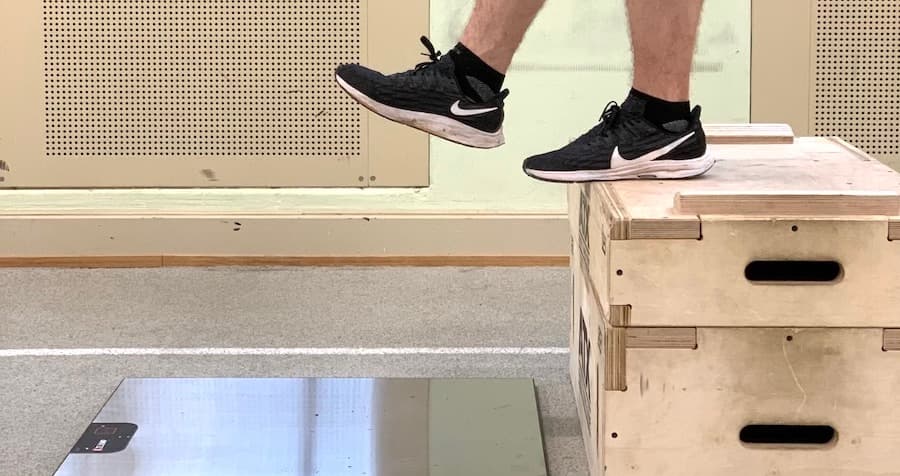
13 test types. One mat.
From a basic countermovement jump to advanced BOSCO protocols and automated fatigue testing — EzeJump covers the full neuromuscular assessment spectrum.
Swift Syncro.
Wireless. Instant.
Pair EzeJump to the Swift Syncro iOS app over Bluetooth in seconds. No cables, no dongles, no receiver hardware — just your phone and the mat.
Every EzeJump system comprises the hardware and a mandatory 12-month Swift Labs 2.0 subscription, billed as its own line at checkout. It covers unlimited athletes, CSV import and export, cloud analysis, coach-shared data, API access, and reports. After the first year, renew annually to keep analysing.
Unlimited Athletes
Swift Labs 2.0
CSV Import / Export
Swift Labs 2.0
Full Cloud-Sync
Swift Labs 2.0
Coach Shared Data
Swift Labs 2.0
API / AMS Access
Swift Labs 2.0
Reports
Swift Labs 2.0
One subscription. Where you analyse.
Priced per mat, per year. Renew annually to keep analysing.
Prices are set per currency and are not converted from exchange rates.
Swift Labs 2.0
per mat, per year. A mandatory 12-month subscription applies with every new EzeJump system.
Billed as its own line, never buried in the hardware price.
- Unlimited athletes
- Full cloud analysis, anywhere
- History, trends and baselines
- Force-velocity profiling
- Team dashboards and multi-coach access
- RTP Baselines
Your hardware
Swift Labs 2.0 is required for the first 12 months. After that it is your call.
- Your gates (or mat) keep capturing and displaying results in Syncro
- Results stay on the device and export to CSV
- Cloud analysis, history and team dashboards pause until you renew
One subscription covers every active device in your organisation.
Swift Labs 2.0 is required for the first 12 months and is charged separately. It renews at US$199 per mat, per year and is optional after year one. Your hardware keeps working either way, your results stay on the device and remain exportable, and analysis stops if you do not renew.
Technical details
| Platform dimensions | 795 × 795 × 16 mm (31.3 × 31.3 × 0.6 in) |
| Weight | 14.0 kg (30.9 lb) |
| Contact zones | 2 (left and right) |
| Total contact area | 740 × 740 mm (29.1 × 29.1 in) |
| Per-zone area | 740 × 360 mm (29.1 × 14.2 in) each side |
| Construction | Stainless-steel top, MDF substructure |
| Switching mechanism | Patented |
| Connectivity | Bluetooth — Swift Syncro app (iOS) |
| Bluetooth range | 10 m (33 ft) |
| Runtime per charge | 200+ hours (approx.) |
| Charge time | 1.5–2 h (approx.) |
| Warranty | 24 months |
Global pricing. Delivered to your door.
Hardware prices are ex-works. Shipping, taxes and bank fees not included. Import tariffs (where applicable) are listed as a transparent line item in your quote.
Vertical jump testing: common questions
What is a vertical jump tester?
A vertical jump tester is a device used to measure how high an athlete can jump. Contact mat systems like EzeJump measure flight time and calculate jump height from the time the athlete is airborne. They also capture contact time, reactive strength index (RSI), and unilateral data from left and right legs independently.
What is a jump mat?
A jump mat is a flat contact mat placed on the floor that detects when an athlete is on the mat and when they are in the air. The mat uses this information to calculate flight time, jump height, contact time, and reactive strength metrics. EzeJump uses a patented stainless-steel switching mechanism for accuracy without drift or calibration.
How do you test vertical jump height?
To test vertical jump height with a contact mat, the athlete stands on the mat, performs a countermovement jump (CMJ) or squat jump, and lands back on the mat. The mat records flight time and calculates jump height using the physics of free fall. For the most accurate results, the athlete should land with straight legs to avoid compressing the flight time measurement.
What is the difference between a jump mat and a jump reach tester?
A jump mat measures jump height from flight time and does not require the athlete to touch anything overhead. A jump reach tester measures the height an athlete can reach while jumping, using a physical vane system. Jump mats are better for bilateral and unilateral jump testing protocols including RSI and BOSCO tests. Jump reach testers are better for combine-style assessments where absolute reach height is the metric.
What is RSI and how is it measured on a jump mat?
RSI (Reactive Strength Index) measures an athlete's ability to rapidly switch from landing to take-off. It is calculated by dividing jump height by ground contact time. A higher RSI indicates better reactive strength and neuromuscular efficiency. EzeJump measures RSI automatically during drop jump and repeated jump protocols, recording both legs independently for unilateral comparison.
What is the difference between a contact mat and a force plate?
A force plate measures ground reaction force throughout the entire jump. A contact mat measures time-based metrics: flight time, contact time, and the metrics derived from them. Force plates cost $15,000 to $30,000 per pair. EzeJump delivers 90% of the data a sport science program needs at a fraction of the cost, including RSI, CMJ height, unilateral asymmetry, and 13 test protocols.
The last jump mat
you'll ever buy.
Request a quote or speak to our team about the right configuration for your program.